Grade 7 Curriculum Tie-Ins for This Land We Call Home

Grade 7 curriculum contexts (pp. 278, 281-282 in the curriculum guide)

PERSONAL AND PHILOSOPHICAL

In this context, students are looking inward and focusing on self-image and self-esteem. They reflect on self and life, on their beliefs and values and those of society.

SOCIAL, CULTURAL, AND HISTORICAL

In this context, students look outward and examine their relationships with others, their community, and that of the world. They also can consider the historical context.

COMMUNICATIVE

In this context, students consider the role of communication in their lives and the ideas and technology that help people become effective communicators.

FINDING THE COURAGE (personal & philosophical) – Ken and Paula both face major challenges as a result of the war: extreme racial prejudice; loss of a brother; loss of property and self-esteem. Both young people are forced to give more than they’d ever imagined, and are tested in difficult ways. Both must weigh and deal with the consequences of promises they have made; both must summon up huge amounts of courage to follow through and make mature choices.

VOICES THROUGH THE AGES – RECONSTRUCTING PAST LIVES (social, cultural & historical; environmental & technological) – Ken’s and Paula’s lives nearly 70 years ago lacked technology and communications media we take for granted today. They must work hard on the farm in addition to going to school; it isn’t as easy for them to enjoy some normal youth activities. Lacking our instant access to information, they must often wait for communications and news, and have few means of checking facts for accuracy. How does this compare to your life today? Do you think it likely that the mass exclusion of a racial minority could happen again, now, in North America?

PARTICIPATING AND GIVING OUR PERSONAL BEST (personal & philosophical) – Ken and Paula are both isolated in certain ways. Paula has a choice between remaining passive and following the role models she sees for young women, or becoming involved to stand up for what she believes is right. In the relocation camp, Ken’s self-esteem plummets; at first he believes the situation is hopeless and that all his dreams have been crushed. Seeing others’ responses to the forced evacuation and incarceration helps him put things in a different perspective: he sees involvement in community activities as a means of working off negative energy, which eventually enables him to re-assess his goals and to give his best in spite of harsh  conditions.

Grade 6 Curriculum Tie-ins for This Land We Call Home

Grade 6 curriculum contexts (pp. 278-280 in the curriculum guide)

PERSONAL AND PHILOSOPHICAL

In this context, students are looking inward and focusing on self-image and self-esteem. They reflect on self and life, on their beliefs and values and those of society.

SOCIAL, CULTURAL, AND HISTORICAL

In this context, students look outward and examine their relationships with others, their community, and that of the world. They also can consider the historical context.

COMMUNICATIVE

In this context, students consider the role of communication in their lives and the ideas and technology that help people become effective communicators.

GROWING UP (personal & philosophical) – Ken and Paula are both emerging from childhood, and are expected to take more responsibility in their family contexts. The extreme conditions of World War II cause both young people to examine their roles and actions more carefully in determining future directions they might take.

LOOKING FOR ANSWERS (personal & philosophical; social, cultural & historical; communicative) – World events related through the news (often distorted by prejudice and rumour) have irrevocable impact on the lives of both Paula and Ken. Each must come to grips with very difficult situations in their family and cultural contexts, and learn to take positive steps as they try to help make a difference.

WWII Japanese Internment Camps: Further Reading

Alison Lohans did a lot of research for her award-winning book This Land We Call Home. Here are some of the resources she used:

SOME RESOURCES – World War II exclusion of persons of Japanese ancestry

Print:

Fiction:

Children’s and young adult:

  • Barry Denenberg, The Journal of Ben Uchida: Citizen 13559, Mirror Lake Internment Camp. Scholastic (New York), 1999.
  • Garry Disher, The Divine Wind. Scholastic (Australia? New York?), 1998, 2002, 2004.
  • Cynthia Kadohata, Weedflower. Atheneum (New York), 2006.
  • (CANADIAN): Joy Kogawa, Naomi’s Road. Oxford University Press (?), 1984(?).
  • Florence Crannell Means, The Moved Outers. Houghton Mifflin (Boston) 1945.
  • Ken Mochizuki, Baseball Saved Us. Lee & Low (New York), 1993(?).
  • David Patneaude, Thin Wood Walls. Houghton Mifflin (Boston), 2004.
  • Allen Say, Music for Alice. Houghton Mifflin (Boston) 2004.
  • Yoshiko Uchida, Journey Home. Aladdin, second edition, 1992.

Adult:

  • David Guterson, Snow Falling on Cedars. Harcourt & Brace (New York), 1994.
  • (CANADIAN): Joy Kogawa, Obasan. Penguin Canada, 1981.
  • Yoshiko Uchida, Picture Bride. University of Washington Press (Seattle), 1987.
  • Wilma Wall, Forbidden. Kregel, 2004.

Nonfiction:

Children’s:

  • Joanne Oppenheim, Dear Miss Breed: True Stories of the Japanese American Incarceration During World War II and a Librarian Who Made a Difference. Scholastic, Inc. (New York), 2006.
  • (CANADIAN): Shizuye Takashima, A Child in Prison Camp. Tundra Books, 1971.

Adult:

  • Maisie and Richard Conrat, Executive Order 9066: The Internment of 110,000 Japanese Americans. The MIT Press (Cambridge, MA), 1972.
  • Roger Daniels, Prisoners without Trial: Japanese Americans in World War II, Revised Edition. Hill and Wang, a division of Farrar, Straus and Giroux (New York), 2004.
  • Deborah Gesensway and Mindy Roseman, Beyond Words: Images from America’s Concentration Camps. Cornell University Press, 1987.
  • Bill Hosokawa, Nisei, the Quiet Americans. William Morrow (New York), 1969.
  • Jeanne Wakatsuki Houston and James D. Houston, Farewell to Manzanar. Bantam, 1974.
  • Lawson Fusao Inada (Ed.), Only What We Could Carry. The Japanese American Internment Experience. Heyday Books (Berkeley) with the California History Society, 2000.
  • Carey McWilliams, Prejudice – Japanese American Symbol of Racial Intolerance. Little, Brown & Company, 1944.
  • Carl Mydans (staff photographer), “Tule Lake”. LIFE Magazine, Vol. 16, No. 12, March 20, 1944, pp. 25-35.
  • (CANADIAN): Tom Sando, Wild Daisies in the Sand. Life in a Canadian Internment Camp. NeWest Press, 2002.
  • Yoshiko Uchida, Desert Exile: The Uprooting of a Japanese-American Family. University of Washington Press (Seattle), 1982.
  • Michi Nishiura Weglyn, Years of Infamy: The Untold Story of America’s Concentration Camps. University of Washington Press (Seattle), 1976, second edition 1999.

Web:

From Wikipedia:

Videos and DVDs:

  • (CANADIAN): Joy Kogawa, The Pool: Reflections of the Japanese-Canadian Internment.
  • Minoru: Memory of Exile.

Germs invade the Book and Brier Patch!

Germs with Germy Johnson's book
Germs with Germy Johnson’s book

Germy Johnson’s Secret Plan was published by Scholastic in 1992 and was widely used in Grade 3 classrooms across Canada. When it went out of print and Alison Lohans kept getting requests for it, she decided to re-issue it. The new edition was released by aamWORKS Publishing in 2008, with new artwork by A.E. Matheson of Saskatoon. At the book launch at Regina’s Book and Brier Patch, Alison and A.E. gave door prizes. Each lucky winner received a copy of the new Germy Johnson’s Secret Plan and a germ! The one with the tentacles is an e.coli and the round white one is a chicken pock.

Continue reading

This Land We Call Home Wins Saskatchewan Book Award

Alison Lohans with the poster of her book This Land We Call Home

Congratulations to Alison Lohans, whose book This Land We Call Home won the 2008 Saskatchewan Book Award in the Young Adult Category!

This is how Alison describes her winning book:
This Land We Call Home addresses the racial prejudice of World War II that led to the evacuation of all persons of Japanese ancestry in the west, into remote relocation camps. Told in alternating points of view, This Land We Call Home is set partly in the area of rural California where I grew up, and also in the Poston (Arizona) Camp III where my mother taught elementary school in 1943-1945. Significant themes include prejudice, and the testing of loyalties and much more as loyal citizens are regarded as enemy aliens and thrust into challenging conditions.”

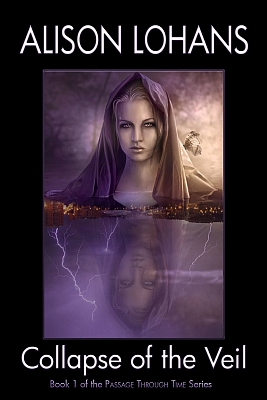
Collapse of the Veil

Collapse of the Veil, by Alison Lohans

Author: Alison Lohans

Escaping her home routine for a few hours, 16-year-old Katie grabs her bike and leaves behind her cranky baby, her hyperactive brother and a struggling single mom. Flopping down in a field to rest, Katie brushes the branches of a willow shrub and falls into a dying world far in the future. The few people there cling to their lore–the tales of terrible destruction that befell the earth; the destruction that is about to hit Katie’s home very soon.

Time travel, psychic phenomena and human emotion all play key roles in the juncture of these two diverse societies. Katie must set aside the normal goals of a typical teenager and decide if she can be the one to help save her two worlds.

Purchase from Alison.


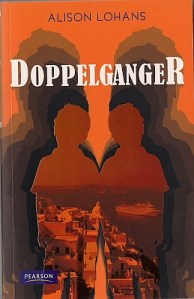
Doppelganger

Doppelganger, by Alison Lohans

Author: Alison Lohans
Publisher: Pearson (New Zealand) 2010
Series: Nitty Gritty Novels Series I

ISBN: 978-1-4425-2763-8

Connor Barclay is spending his Easter holidays on a cruise to Greece and Turkey. Awesome! True, his dad couldn’t come and he has to share a tiny crowded cabin with his mum and bratty little sister. But he has his favourite computer game, Doppelganger, to while away any downtime.

Oddly, though, some of Connor’s fellow passengers seem to regard him as a troublemaker and, when he goes ashore, shopkeepers yell at him in Greek and Turkish for no reason that he can see. Can it have something to do with the boy he saw who seemed to be wearing his favourite soccer shirt? The boy who looks exactly like him…

Order from Pearson Education or from Alison.

See a CM Review.